Progressive disclosure is the most misunderstood pattern in documentation UX.
Most teams read it as "hide complexity behind a click." That is not what it is. It is about matching information to the reader's current question, not sequencing information by length, and not deferring rendering with an accordion.
This is the second piece in the Docs as Interface series. The first post made the case that documentation is no longer a destination. It is backend content for five different delivery surfaces: docs portal, in-app help, chatbot, API reference, and AI assistant. If that shift is real, then every content pattern we inherited from the portal era needs to be re-examined. Progressive disclosure is the first one worth reopening, because it is the pattern most teams get wrong even inside the portal, and the one that breaks hardest when content gets pulled into smaller surfaces.
The misread definition
The "hide complexity" reading is everywhere. Accordion components. "Show advanced options" toggles. Collapsed code samples. These are valid UI patterns, but they are not progressive disclosure in the documentation sense. They are progressive reveal. A cosmetic layer that defers rendering, not a structural decision about information order.
True progressive disclosure is an IA problem, not a component problem. You are not deciding when to show content. You are deciding what question each piece of content is answering, and whether the reader has arrived at that question yet.
That distinction matters more now than it did two years ago. When the docs portal was the only surface, getting disclosure wrong meant a messy page. Today, the same content gets extracted into a tooltip, rephrased by a chatbot, surfaced in onboarding, and quoted by an AI assistant. If your content is structured around the writer's logic instead of the reader's question, every downstream surface inherits that inversion.
One sentence, four surfaces
Here is the example that made this concrete for me.
A docs page contains this sentence:
Deleting this configuration may impact downstream models that depend on it.
Now watch what happens to that sentence across a modern product.
On the docs page, it sits inside a Reference topic about configuration management. It is accurate, qualified, and surrounded by context about which model types depend on which configurations.
In a tooltip on the Delete button, someone shortens it to "Deleting this config may affect other models." Softer. Vaguer. The warning is still present but the causal link has evaporated.
In the onboarding tour, a UX writer who never saw the original sentence writes "You can delete configurations you no longer need." True in isolation. Actively misleading when placed next to a live Delete button.
In a chatbot answer to "can I delete this config," the model pulls the original sentence, but strips the qualifier that made it accurate. The user gets "Yes, configurations can be deleted."
Four surfaces. One concept. Four different sentences, written by three different humans and one language model, none of whom were looking at the other three. The user stitches them together into a mental model that is wrong, and then deletes the configuration.
This is what broken progressive disclosure looks like in 2026. It is not a long page the reader has to scroll through. It is the same information rendered four times at different depths, with no system ensuring those renderings stay aligned.
A question hierarchy, not a content hierarchy
The reframe that actually fixes this: progressive disclosure is a question hierarchy, not a content hierarchy.
Readers arrive with an ordered stack of questions. "What is this" sits on top. "Will it work for my case" sits under it. "How do I install it" comes third, and only if the first two resolved favorably.
The question hierarchy for most developer-facing content looks roughly like this:
- What is this, in one sentence? If the reader cannot answer this after the first paragraph, nothing else lands.
- Will this work for my situation? A single concrete example, in their language, resolves this faster than any feature list.
- How do I get started? Installation, prerequisites. Only relevant once questions 1 and 2 are answered.
- How do I configure it for my specific case? Belongs on a separate page entirely, not below the install steps.
- What is the full API surface? Reference material. Not a landing page concern at all.
Most docs skip directly to question 3. Some skip to question 5. Almost none open with a working example that answers question 2 before touching installation.
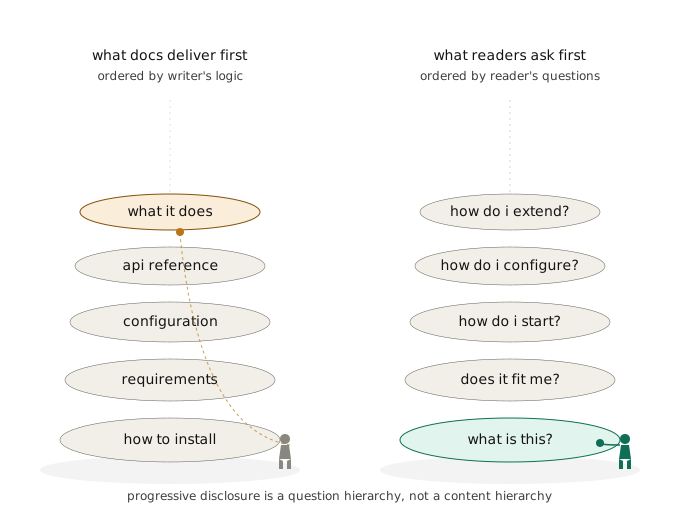
The gap between the order docs deliver and the order readers ask is where bounce happens.
The disclosure-by-surface matrix
The question hierarchy applies per surface, not just to the docs page. Each surface can only answer the questions the reader has at that moment. Writing the same content four times at four depths, and keeping those versions aligned, is the actual craft of modern documentation.
Here is the matrix I use when content touches more than one surface:
| Surface | Question it answers | Length | Failure mode |
|---|---|---|---|
| Tooltip | What happens if I click this? | One line | Vagueness that removes the warning |
| In-app help | How do I complete this task right now? | Three to six lines | Missing the qualifier that makes it safe |
| Onboarding | What is this whole capability? | A paragraph | Cheerful framing that hides risk |
| Chatbot answer | The specific question the user asked | Two to four sentences | Stripped qualifiers from the source |
| Docs page | The full concept and its edge cases | Full depth | Nobody reads it because the surfaces above already answered wrong |
The craft is keeping the causal link intact across every row. "Deleting this configuration may impact downstream models" has to stay "may impact downstream models" in every surface that touches the Delete action, even when the length changes. The moment you shorten it to "may affect other settings," you have lost the only word that mattered.
This is not achievable through willpower or review cycles. It needs to be a structural property of the content. Which is what the Docs as Interface thesis was about in the first place: a single structured content source, a quality gate that enforces both documentation and UX principles, and a single owner of the pipeline.
The Monday-morning diagnostic
Reading about this does nothing. Here is what to actually do.
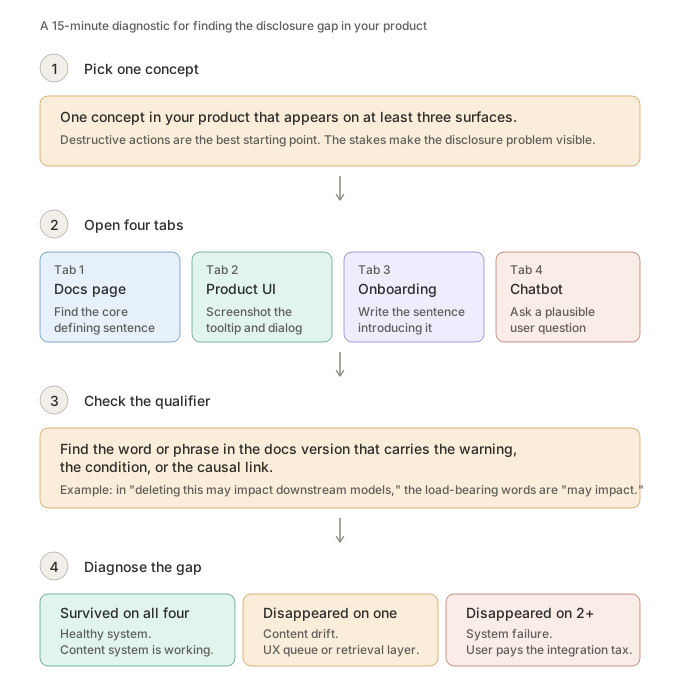
A fifteen-minute diagnostic for finding the disclosure gap in your product.
Pick one concept in your product that appears on at least three surfaces. A destructive action is a good choice because the stakes make the disclosure problem visible.
Open four browser tabs.
Tab one: the docs page for that concept. Write down the core sentence that defines what happens.
Tab two: the product UI where the action lives. Screenshot the tooltip, the confirmation dialog, any inline help.
Tab three: the onboarding tour or getting-started flow. Find where this capability is first introduced. Write down the sentence.
Tab four: your chatbot or AI assistant. Ask it a plausible user question about the action. Write down the answer.
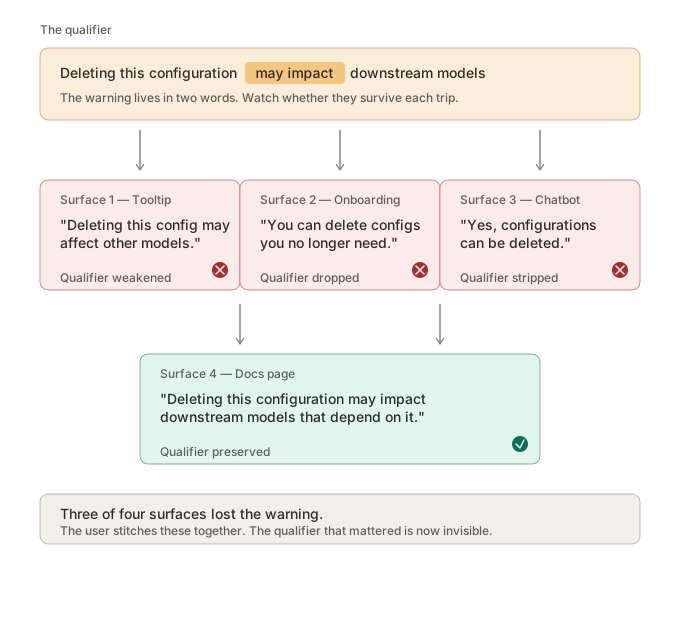
Three of four surfaces lost the qualifier. The user stitches these together and the warning is invisible.
Now put the four sentences in a row and look for the qualifier. The word or phrase in the docs version that carries the warning, the condition, or the causal link. Check whether it survived the trip to each of the other three surfaces.
If it survived on all four: your content system is doing its job.
If it disappeared on one: you have a drift problem, probably in the UX writer's queue or the chatbot's retrieval layer.
If it disappeared on two or more: the content is not being treated as a connected system. Each surface is being written in isolation, and the user is paying the integration tax.
That is your disclosure gap. It took fifteen minutes to find. Fixing it is a longer conversation, but you cannot fix what you have not named.
What to take from this
Progressive disclosure in 2026 is not "hide complexity behind a click." It is "write the same information at the depth each surface can hold, and keep those versions aligned as the content changes."
That is a content architecture problem, not a UI problem. It is why the role of documentation engineer is becoming real. Somebody has to own the matrix, enforce the alignment, and catch the drift before the user does.
Part 3 of this series will be about the other half of the problem: what happens when the user never sees your docs page because the chatbot answered first. If your content is the backend data source for a conversational interface, what does good structure actually look like? I will take that one apart next.
Until then, run the four-tab diagnostic on one concept in your own product this week. Tell me what you found. The gap is almost always bigger than you expect.
Sulagna Sasmal is a Documentation Engineer, Information Architect, and AI Tools Builder. She writes about the systems behind documentation, not just the words inside it.
Portfolio: sulagnasasmal.com · Blog: sulagnasasmal.github.io/blog · GitHub: github.com/SulagnaSasmal
Discussion
Have a question or a different take? Drop a comment below. GitHub account required.