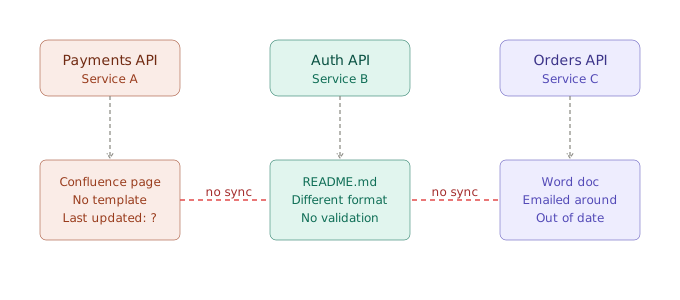
Most API documentation problems are not writing problems. They are structure problems. Format problems. Consistency problems. The kind that compound quietly until a developer opens your docs at 11pm and cannot tell whether the endpoint they’re reading is current, deprecated, or simply documented differently from the one before it.
I have spent twenty years watching this happen across financial platforms, compliance systems, and SaaS products. The documentation itself was often fine. The system holding it together was not.
RepoDocs AI is my attempt to build that system.
What it is
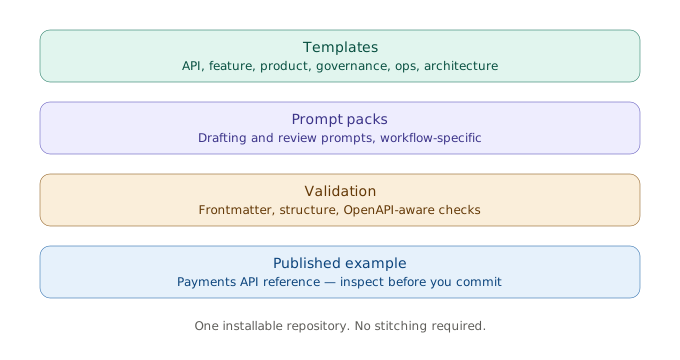
RepoDocs AI is a repository-based documentation system for SaaS API teams. It combines documentation structure, AI-assisted drafting workflows, validation, and a payments API reference example in one installable package.
The distinction that matters: it is not a folder of templates. Templates without guardrails just move the inconsistency problem one level upstream. RepoDocs AI adds prompt packs for drafting and review, frontmatter and OpenAPI-aware validation, and a published payments example that shows you the expected output quality before you commit to the system.
The target audience is engineering teams, API platform teams, developer relations teams, and technical writers working in Git-based workflows. If your documentation lives in a repository and your team still struggles with format consistency, slow first drafts, and docs that drift after release, this is built for the gap you are in.
The problem I was actually solving
Four things break API documentation at most SaaS companies.
Different services get documented in different formats because no one standardized the structure before the third team started. Manual documentation creation is slow enough that it gets deprioritized until the sprint is over, which means it gets deprioritized until the next sprint too. AI-generated drafts are low-trust without guardrails because there is no structure enforcing what a good draft looks like. And documentation drifts because validation and review workflows are weak or manual or both.
None of these are problems you solve by writing better. You solve them by building a system that makes the right output easier than the wrong one.
What makes it different from a template pack
Normal documentation template packs stop at static files. You clone the repo, copy the templates, and then reconstruct the workflow around them yourself.
RepoDocs AI adds the workflow layer. Reusable templates across product, feature, API, governance, operations, and architecture documentation. Prompt packs for drafting and review that are workflow-specific rather than generic. Validation that checks frontmatter, structure, and OpenAPI alignment before content reaches review. A payments API example you can inspect as a published site rather than guess at from a README promise. And export pipelines for teams that need publishing support beyond the static site.
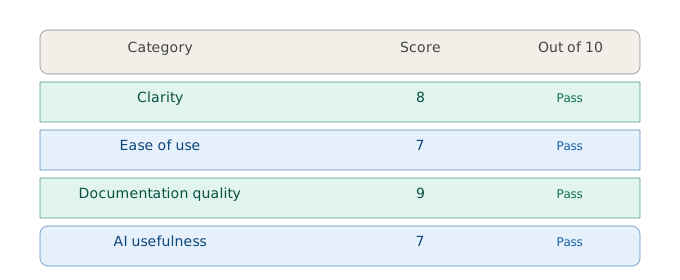
The Developer Experience Scorecard is also part of the system. It is a structured usability test: give a tester only the repository link and README, then score clarity, ease of use, documentation quality, and AI usefulness. The pass threshold is 7 out of 10. I ran my own self-assessment in March 2026 and scored 7.75. The scorecard is public and open for community assessments.
How to evaluate it
The shortest path from claim to proof is this:
- Install it: the bootstrap command takes under 5 minutes, including the Windows PowerShell path.
- Inspect the payments example: a realistic API doc set, not a placeholder.
- Review the validation suite: structure enforced by rules, not by memory.
If after those three steps the system looks credible for your team, the templates, prompts, and examples are there to copy into your own repository and adapt.
The full product is at sulagnasasmal.github.io/repodocs-ai. The repository is open on GitHub.
What comes next
The pipeline health checker is coming next, a diagnostic tool that maps where content breaks when it crosses delivery surfaces, and what gate would have caught it. It fits into the RepoDocs AI ecosystem as a companion rather than a separate product.
If you are an API team lead, a developer relations engineer, or a technical writer building in public, I want to hear what breaks in your documentation workflow. Open a GitHub Discussion or submit your own API spec using the issue template on the repo.
Sulagna Sasmal is a Documentation Engineer and AI Tools Builder with 20 years of enterprise software documentation experience. RepoDocs AI is part of her public portfolio at sulagnasasmal.github.io/ai-doc-tools.
Discussion
When was the last time an AI tool generated documentation that passed your review without edits? Not 'good enough to fix.' Actually passed.