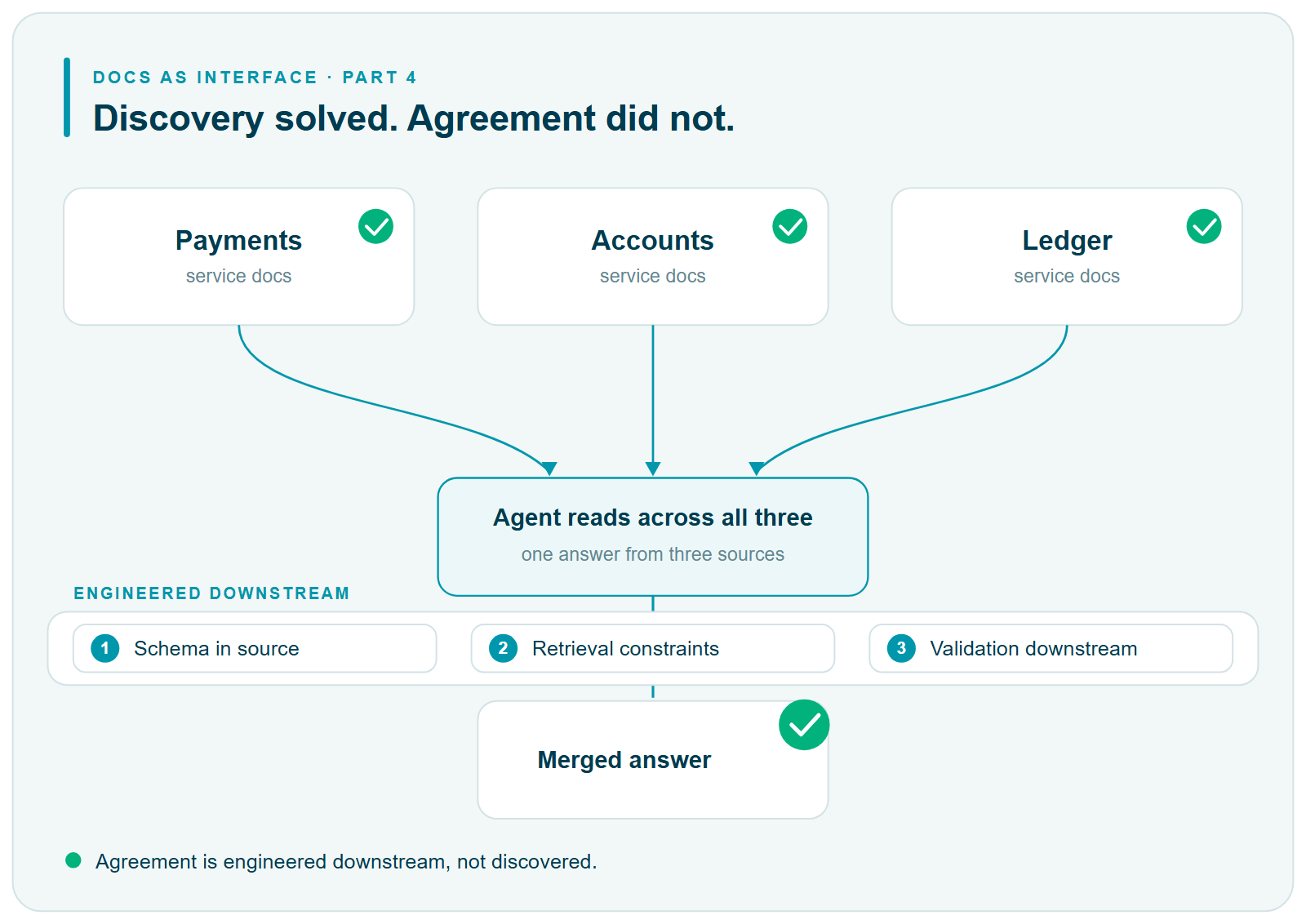
Docs as Interface, Part 4: Federation Solved Discovery. It Didn't Solve Agreement.
Three sources can return three answers. Federation made the disagreement legible. It did not resolve it. Here is where agreement actually has to live.
Three sources can return three answers. Federation made the disagreement legible. It did not resolve it. Here is where agreement actually has to live.
When the chatbot answers first and your page is the data source behind it, you are not writing the last thing the user reads. You are writing the input to whatever writes it. Here is what that changes.
Part 2 of Docs as Interface. Most teams read progressive disclosure as hide complexity behind a click. That is not what it is. Here is how to apply it across every surface your documentation now reaches, and a 15-minute diagnostic you can run on your own docs on Monday.
Technical writers build content. UX designers build interfaces. For twenty years, these two disciplines have operated in separate buildings, separate tools, separate reporting lines. That worked when documentation lived on a portal and the product lived on a screen. Users moved between two worlds: the application where they did their work, and the help center where they went when they got stuck. That world is ending. AI chatbots now pull documentation into the product and surface it as conversational answers. In-app guidance layers docs content directly onto the interface. Newer tools can expose your knowledge base as something an AI assistant can query directly. The documentation portal is no longer the destination. It is the backend data source for five different delivery surfaces, and neither the tech writer nor the UX designer fully owns the pipeline that connects them. ...